The chemical allies that can define the efficiency of an industrial process.
Antifoams and defoamers
If you have ever seen a production line stop because of an unexpected overflow, a fermentation process lose effective capacity, or a wastewater treatment system produce erratic readings due to entrained air, then you are already familiar with one of the most underestimated operational challenges in industry: foam.
While often perceived as a minor nuisance, foam generation can significantly impact production efficiency, process stability, product quality, and operating costs. Across industries ranging from food processing and pharmaceuticals to water treatment and oil & gas, uncontrolled foam can reduce throughput, compromise equipment performance, and increase maintenance requirements.
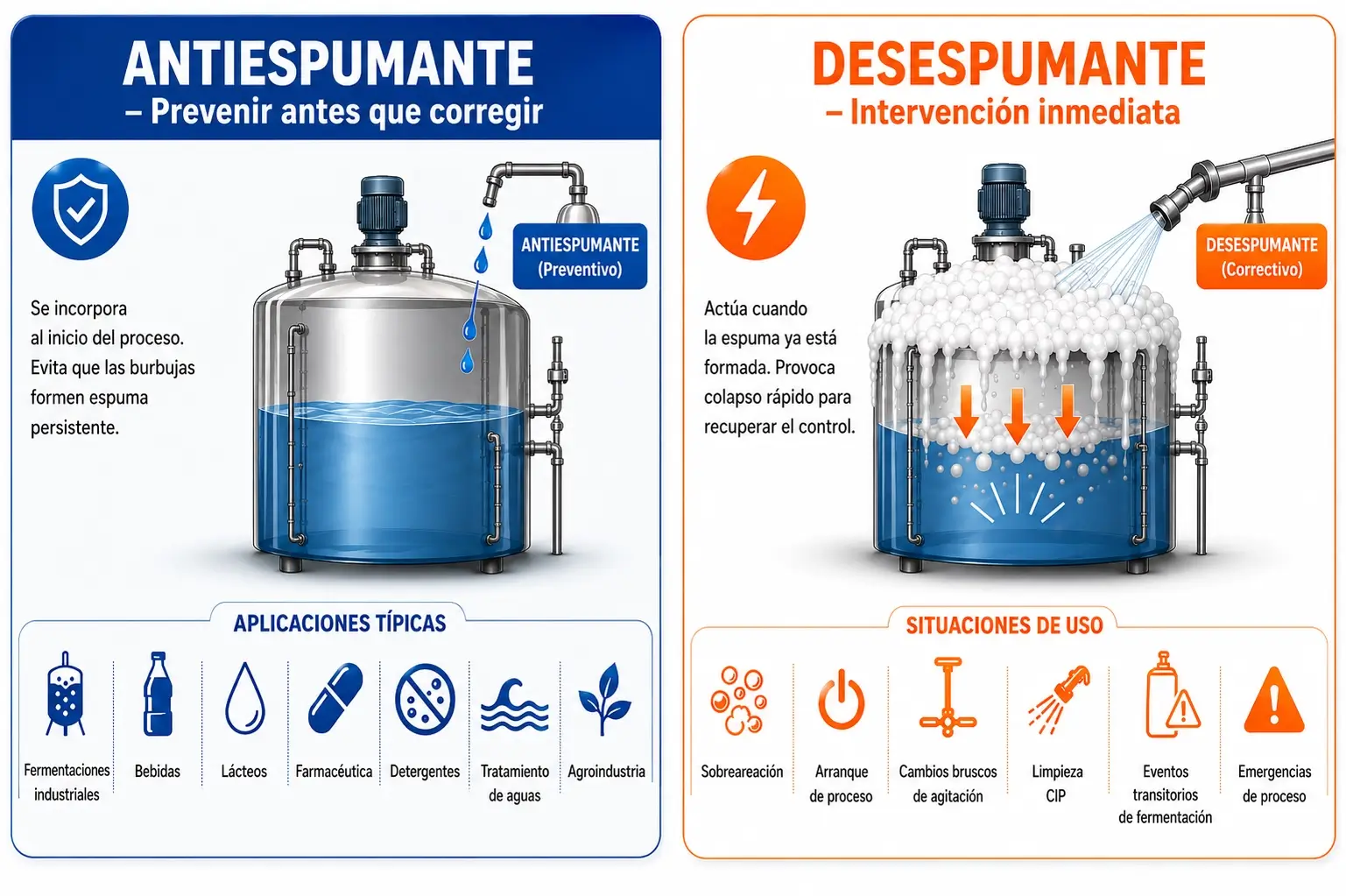
Understanding the difference between antifoams and defoamers is essential for selecting the right foam control strategy and maximizing operational efficiency.
Why Is Foam an Industrial Problem?
Foam is a gas dispersion in a liquid medium stabilized by surfactants present in the system. When these films become sufficiently stable, undesirable effects emerge, such as:
The severity of the problem increases in operations with high aeration, recirculation, mechanical agitation, or the presence of surface-active biomolecules, conditions commonly found in the food, pharmaceutical, agribusiness, cosmetics, chemical, and water treatment industries.
The key is to know which type of antifoam and/or defoamer to use
If you have ever seen a production line stop because of an unexpected overflow, a fermentation process lose effective capacity, or a wastewater treatment system produce erratic readings due to entrained air, then you are already familiar with one of the most underestimated operational challenges in industry: foam.
While often perceived as a minor nuisance, foam generation can significantly impact production efficiency, process stability, product quality, and operating costs. Across industries ranging from food processing and pharmaceuticals to water treatment and oil & gas, uncontrolled foam can reduce throughput, compromise equipment performance, and increase maintenance requirements.
Understanding the difference between antifoams and defoamers is essential for selecting the right foam control strategy and maximizing operational efficiency.
The Right Selection Directly Impacts Profitability
In many organizations, foam control is addressed only when a visible problem occurs.
However, from a process engineering perspective, foam must be treated as a critical operating variable.
An effective foam control strategy makes it possible to maximize effective production capacity, improve operational stability, and reduce the risks associated with process deviations.
How to Select the Right Antifoam Technology
Selecting an antifoam solely based on immediate foam reduction can lead to poor long-term performance and unnecessary operating costs. The most effective solution depends on the specific conditions of the process.
When evaluating an antifoam or defoamer, manufacturers should consider:
Process Conditions
Operating temperature, pH range, Agitation intensity, Air entrainment levels, Residence time.
Product Composition
Presence of surfactants, Protein concentration, Oil content, Solids content, Viscosity.
Regulatory Requirements
Food-contact application, Pharmaceutical processing, Kosher or Halal requirements, Regional regulatory compliance.
Operational Objectives
Long-term foam prevention, Immediate foam collapse, Dry-blend compatibility, Silicone-free requirements, Wastewater treatment compatibility.
Because foam generation mechanisms vary significantly among industries, selecting the right technology often requires application-specific evaluation and plant-level testing.
ZERACHEM® Solutions for Every Industry
At ZERACHEM®, we develop specialized foam control solutions for industries that cannot afford interruptions. Our approach combines chemical expertise, technical support, and formulations designed to perform under real plant conditions, turning foam control into a competitive advantage for our customers.

KOSHER
Certified

Agile
Reformulation

Permanent
Stock

Full Regulatory
Compliance

Technical
Sustainability

Organized
Logistics

Specialized
Consulting

Free
Samples
Need Help Selecting the Right Foam Control Solution?
Our technical team works directly with manufacturers to identify the most effective antifoam or defoamer technology based on process conditions, regulatory requirements, and operational objectives.
Contact ZERACHEM® to discuss your application and request technical guidance.
Explore Our Solutions
Antifoamzera A20
Food-Grade Defoamers
Characteristics:
- White viscous liquid.
- Silicone-based with nonionic emulsifiers.
- Solids content: 22-28%.
- Viscosity: 400-4000 cP.
- pH: 4.0-7.0.
- Dosage: 100-500 ppm.
- Shaker test: ≤0.5 cm foam.
- Stable under centrifugation.
Main Applications:
- Control of foam in aqueous systems.
- Eliminates surface foam and releases entrained air.
- Mixing, fluid transfer, and packaging operations.
- Bottle cleaning operations.
- Water treatment.
Industry:
Food industry and Pharmaceutical industry.
Antifoamzera A30
Food-Grade Defoamers
Characteristics:
- White viscous liquid.
- Silicone-based formulation containing nonionic emulsifiers suitable for applications subject to applicable FDA regulations.
- Solids content: 27-34%.
- Viscosity: 500-2000 cP.
- pH: 3.0-7.0
- Dosage: 50-150 ppm.
- Storage stability: 1 year.
- Shaker test: ≤0.5 cm foam.
- KOSHER certification.
- USP analysis.
Main Applications:
- Distillation processes (including spirits and alcoholic beverages).
- Dairy products (dulce de leche, sweetened condensed milk, powdered milk, milk-based confections).
- Juices, fruit concentrates, jams.
- Fermentation processes involving sugars, grains, fruits, and other biological feedstocks.
- Confectionery (hard candy, soft candy, sugar cubes), chocolates. Fats and oils (butter, margarine).
- Instant soups and broths.
Antifoamzera
Powder Food Grade
Food-Grade Defoamers
Characteristics:
- Slightly yellow powder.
- PDMS ≤20%.
- Moisture <7.0%.
- pH: 4.0-7.0.
- Water solubility: 60-100%.
- Mesh size: ≈80.
- Shaker test: ≤0.5 cm foam.
Main Applications:
- Designed for foam control in dry-blend formulations and fermentation processes.
- Alcoholic beverage distillation, dairy processing, coffee, juices, jams, confectionery, chocolates, seasonings.
Industry:
Food and beverage industry; Pharmaceutical industry.
Antifoamzera I30
Industrial Defoamers
Characteristics:
- White viscous liquid.
- Solids content: 27-34%.
- Viscosity: 500-2000 cP.
- Silicone emulsion.
- Shaker test: ≤0.5 cm foam.
Main applications:
- Foam control in demanding environment
- Elimination of surface foam and entrained air.
- Particularly effective in gas-liquid separation systems.
Industry:
Chemical industry, textile industry, Acid production, Bottle cleaning operations, paper, water treatment, oil and gas (extraction, natural gas production, phase separation).
Antifoamzerabreak W
Industrial Defoamers
Characteristics:
- Milky white to slightly beige liquid (ethoxylated alcohols + vegetable oils base, silicone-free).
- Solids: 18-30%.
- pH: 3.0-7.0.
- Completely miscible in water.
- Biodegradable.
- Shaker test: ≤0.5 cm foam.
Main applications:
- Prevents and eliminates foam in aqueous industrial systems.
- Industrial washing, agrochemical and fertilizer formulation, water treatment, manufacture of paints, varnishes, adhesives, and textile processes (washing, dyeing, finishing).
Industry:
Chemical industry, industrial washing, agrochemicals, wastewater treatment, paper and pulp, paints and coatings, textile, adhesives and sealants.
Antifoamzera Non-Silicone
Industrial Defoamers
Characteristics:
- White viscous liquid (aliphatic oil base, silicone-free).
- Solids content: 22-28%.
- Viscosity: 400-4000 cP.
- pH: 4.0-7.0.
- Dosage: 100-500 ppm.
- Storage stability: 1 year.
- Shaker test: ≤0.5 cm foam.
Main applications:
- Targeted foam control for industrial processing applications.
- Prevents foam formation throughout the production process, from mixing to final packaging.
Industry:
Chemical industry, Acid production, Bottle cleaning operations, agrochemical manufacturing, paper production, water treatment, vinyl paint industry.
Antifoamzerabreak
Industrial Defoamers
Characteristics:
- Dark brown viscous liquid (ethoxylated alcohol + 80% active palm vegetable oil base).
- Solids: 75% min.
- Viscosity: max. 2500 cP.
- pH: 3.0-7.0.
- Stability: 1 year.
- Biodegradable.
- Shaker test: ≤0.5 cm foam.
Main applications:
- Reduces and prevents foam by destabilizing foam films and lowering surface tension.
- Bottle cleaning operations, agrochemical and fertilizer manufacturing, water treatment, solvent-based paints, varnishes, coatings, textile finishing, adhesives, and sealants.
Industry:
Chemical industry, industrial washing, agrochemicals, paper and pulp, water treatment, paints and coatings, textile, adhesives and sealants.
Antifoamzera I20
Industrial Defoamers
Characteristics:
- White viscous liquid.
- Solids content: 22-28%.
- Viscosity: 400-4000 cP.
- pH: 4.0-7.0.
- Dosage: 100-500 ppm.
- Stable under centrifugation.
- Shaker test: ≤0.5 cm foam.
Main applications:
- Foam control in aqueous media.
- Eliminates surface foam and releases entrained air.
- Mixing, fluid transfer, and packaging operations.
Industry:
Chemical industry in general, textile industry, Acid production, Bottle cleaning operations, paper production, wastewater treatment, oil and gas.
Important: Product suitability for food, beverage or pharmaceutical applications must be evaluated according to applicable regulations, process conditions and final product requirements.
Regulatory and Technical Disclaimer
The information provided in this article is intended for educational and informational purposes only. Product performance may vary depending on process conditions, formulation composition, operating parameters, and application requirements.
Any suitability assessment for food, beverage, pharmaceutical, or other regulated applications should be conducted according to applicable local regulations and customer-specific requirements.
ZERACHEM® products should be evaluated under actual process conditions before commercial implementation.
Why Partner With Us
30 Years Focused on Chemical Excellence
Backed by quality certifications, reliable logistics, and a comprehensive chemical portfolio tailored to your industry.
KOSHER
Certified
Agile
Reformulation
Permanent
Stock
Full Regulatory
Compliance
Technical
Sustainability
Organized
Logistics
Specialized
Consulting
Free
Samples
PRODUCT SOLUTIONS
Get direct access to our specialty product line: antifoams, emulsions, degreasers, and more.
INDUSTRY SOLUTIONS
Explore the solutions we’ve already formulated to address the unique demands of your sector.
Let’s start your next project.
Let’s start your next project
Describe your needs and let’s put the plan into action: technical assessment, samples for your validation and approval, and full support to implement the raw material that best fits your requirements and process.
We’re ready!