
ANTIFOAMERS, YES BUT WHERE?
Controlling foam in industrial processes is not a simple task. Even when the right antifoam has been selected and the correct dosage is used, difficulties may still arise in controlling foam or preventing its effects on the final product. So, what could be the problem? This is one of those cases where the order of operations DOES affect the outcome.
The addition point of an antifoam can be just as important as the product selection or the dosage used. Depending on the process characteristics, it may be necessary to prevent foam formation before it occurs, control foam generation during a specific operation, or remove entrapped air before obtaining the final product. For this reason, there is no universal addition point: the strategy must be defined by identifying when, where, and why foam is generated within the process.
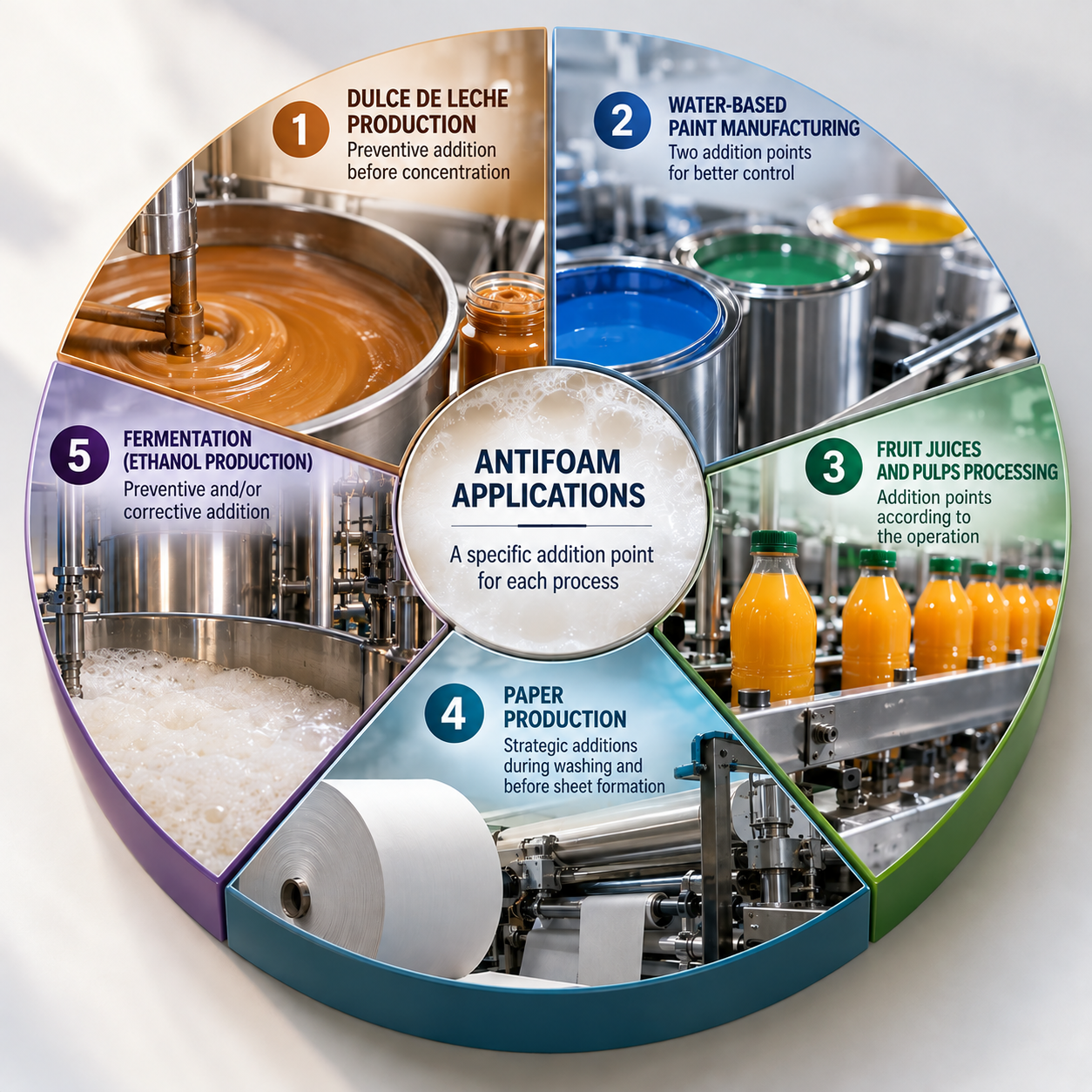
In this article, we illustrate this phenomenon with different examples based on the experience of our customers across different industrial sectors. We will see that foam can affect not only the process but also the finished product and, in some processes, both. Below, we present examples of this behavior.
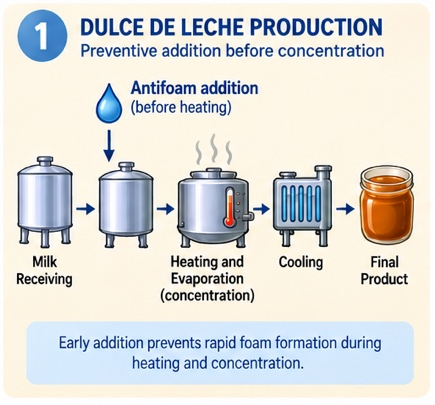
Dulce de Leche Production
During water evaporation by heating (approximately 100°C), the temperature induces, among other phenomena, processes such as protein denaturation, which can contribute to the formation of large amounts of foam in a short period of time. Rapid foam formation can make control difficult, as some people may have experienced when heating milk at home.
Key addition point:
For this type of process, it is recommended to add the antifoam before the concentration stage begins. Early addition prevents foam formation from the start of heating because, in this particular case, foam forms very rapidly and does not allow enough time for effective control.
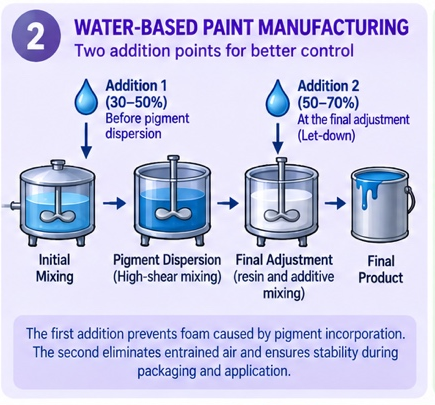
Water-Based Paint Manufacturing
Foam and entrapped air in water-based paints can cause surface defects and affect the final appearance and quality of the coating; one such defect is known as “fish eyes.” Therefore, it is important to identify the key antifoam addition points to prevent imperfections during final product application. In this case, foam and entrapped air may not represent a critical process limitation, but they can become a significant problem for the quality and appearance of the finished product.
Key addition point:
For this process, addition at two points is recommended.
During the grinding (dispersion) stage, the antifoam is added before high-speed dispersion to prevent foam caused by the incorporation of powders and pigments into the mixture. Usually, 30–50% of the additive is added.
During the let-down operation, the second portion of the antifoam (50% to 70%) is recommended at the end, just before or after resin emulsification/mixing, to remove entrapped air during final agitation and ensure stability during filling and application.
In other words, the total antifoam dosage should be divided:
- 30–50% is added during the grinding stage.
- 50–70% is added during the final let-down stage.
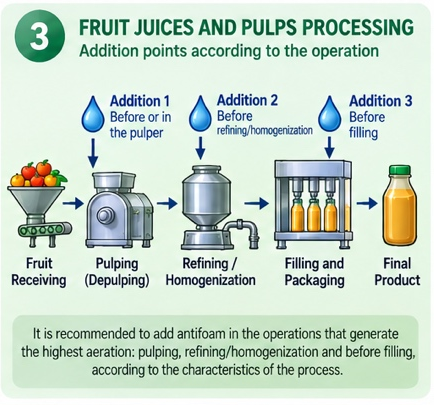
Fruit Juices and Pulps
During pulping, refining, and homogenization, the fruit undergoes mechanical processes that introduce air and, given the presence of natural surfactants in fruit such as saponins, generate foam. This foam causes oxidation, vitamin loss, changes in color and flavor, and makes filling and packaging the final product more difficult.
Key addition point:
In this sector, addition points should be defined according to the level of aeration generated in each operation and the specific characteristics of the process. However, the experience of some companies leads to the following recommendations:
- During the pulping operation: It is recommended to add the antifoam directly into the pulper or the receiving tank before starting the process.
- During homogenization or refining: If the pulp undergoes these operations, antifoam should also be added before the process to control aeration caused by equipment friction.
Due to the high speeds of the filling process, turbulence can generate foam, so the antifoam should be added immediately before this operation to prevent filling and packaging problems.
NOTE: It is important to assess whether the total dosage needs to be divided between two or three addition points and, in some cases, to pre-dilute the emulsion to facilitate its incorporation into the process. Compliance with the limits established by current regulations must also be verified, taking into account that the additive may remain in the final product.
Paper Production
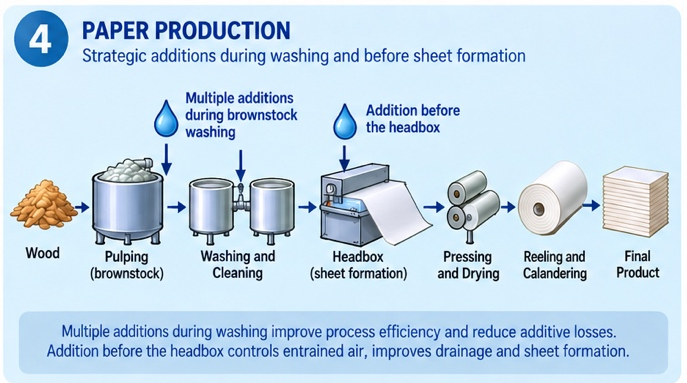
Foam in papermaking reduces drainage rates, affects final product quality for example, through the formation of holes or pinholes and can cause deposit problems. Therefore, it can affect both process efficiency and final product quality.
Key addition point:
During brownstock washing: A multiple-point addition strategy is recommended throughout the washing system due to the loss of efficacy caused by consumption, carryover, or distribution of the antifoam along the process.
Before paper sheet formation: On the paper machine, addition is made to the incoming flow before the headbox to control entrapped air that affects drainage and sheet formation.
Fermentation (Ethanol Production)
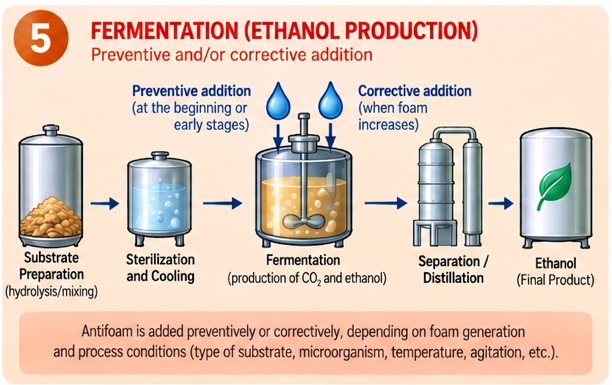
During the fermentation of sugars to produce alcohol, CO₂ generation together with the presence of organic substances with surfactant properties produces large amounts of foam, which reduces reactor capacity, causes overflow, and affects process yield and productivity.
Key addition point:
The antifoam addition strategy should be defined according to foam behavior during fermentation. In some processes, it may be appropriate to make a preventive addition at the beginning or during the early stages, while in others it may be more suitable to start dosing when a significant increase in foam formation is observed.
It is important to consider that foam behavior during fermentation can vary depending on many factors (strain or microorganism, sugar concentration, temperature, nutrients, fermenter design, agitation intensity, process control system). Therefore, a specific timing cannot be recommended; for some processes it may be during the first hour, while in others it may be after four hours.
Keep in mind…
- Manual addition is performed by visually observing the foam at the top of the fermentation tanks.
- Pre-diluting the antifoam in water facilitates its dispersion and prevents overdosing.
The recommendations presented are general examples based on application experience. Antifoam selection, dosage, and addition point must be validated under the specific conditions of each process.
In conclusion…
There is no single antifoam addition point for all processes. The location, timing, and dosing strategy for the antifoam must be defined based on where, when, and under what conditions foam is generated.
At Zerachem®, we have decades of experience in the application of this type of additive. Our team can support you in selecting and evaluating the antifoam, determining the appropriate dosage and dosing strategy, as well as in product qualification processes against other products.
References
- Martin A. Hubbe. Foam and its Control in Pulp and Paper Manufacturing: A Review of Chemical Principles and Governing Factors. BioResources 21 (3), 9252–9310. DOI:10.15376/biores.21.3.Hubbe2
- Daniela Cristina Tapia Chacón. Effect of the use of different antifoam in the anaerobic fermentation of CCN-51 cocoa mucilage at different concentrations of Saccharomyces cerevisiae yeast and its influence on bioethanol production. 2019. Undergraduate thesis.
Frequently Asked Questions
Which antifoam should I use for my industrial process?
This depends heavily on the process conditions, as there is no universal antifoam. To select the right product, at a minimum, the following factors should be considered:
- Process type: water treatment, food, paints, paper, textiles, fermentation, chemicals, detergents, etc.
- Medium: aqueous, solvent-based, alkaline, acidic, emulsion, suspension, etc.
- Temperature and pressure.
- Level of agitation or aeration.
- When the foam appears.
- Compatibility with the final product and regulatory requirements.
Therefore, rather than looking for “the most powerful antifoam,” the goal should be to find the antifoam that is compatible with the specific conditions of your process.
How do I choose an industrial antifoam?
A practical approach is to evaluate five variables:
Process → Foam → Conditions → Restrictions → Dosage
First, identify what is generating the foam and then select a formulation capable of working under those conditions.
For example, a process involving high temperature, strong agitation, and alkaline pH requires a different formulation from a low-temperature process with no agitation.
It is also important to consider whether the antifoam must meet specific requirements related to food contact, water treatment, biodegradability, VOCs, silicone residues, or other specifications.
What is the best antifoam for foam control?
There is no single antifoam that is universally “the best.” An antifoam can perform extremely well in one process and be less effective in another. In general:
| Type (active ingredient) | Main characteristic | Common applications |
|---|---|---|
|
Silicone-based |
High efficiency at low dosage. |
Industrial processes, water treatment, chemicals, textiles, food, paints, paper and cardboard, oil and gas, water treatment. |
|
Polymeric / non-silicone |
Good compatibility and lower risk of silicone contamination. |
Paints, coatings, and some chemical processes. |
|
Mineral oil-based |
Good cost-to-performance ratio in certain applications. |
Industrial processes and water treatment. |
|
Esters / fats |
Useful in specific applications. |
Food and processes requiring particular formulations. |
The selection should be based on a detailed literature review, complemented by laboratory testing and, subsequently, plant trials. To qualify our solutions against the products you have been using in your process at Zerachem®, we provide specialized technical support.
Which antifoam should I use for my industrial process?
This depends heavily on the process conditions, as there is no universal antifoam. To select the right product, at a minimum, the following factors should be considered:
- Process type: water treatment, food, paints, paper, textiles, fermentation, chemicals, detergents, etc.
- Medium: aqueous, solvent-based, alkaline, acidic, emulsion, suspension, etc.
- Temperature and pressure.
- Level of agitation or aeration.
- When the foam appears.
- Compatibility with the final product and regulatory requirements.
Therefore, rather than looking for “the most powerful antifoam,” the goal should be to find the antifoam that is compatible with the specific conditions of your process.
How do I choose an industrial antifoam?
A practical approach is to evaluate five variables:
Process → Foam → Conditions → Restrictions → Dosage
First, identify what is generating the foam and then select a formulation capable of working under those conditions.
For example, a process involving high temperature, strong agitation, and alkaline pH requires a different formulation from a low-temperature process with no agitation.
It is also important to consider whether the antifoam must meet specific requirements related to food contact, water treatment, biodegradability, VOCs, silicone residues, or other specifications.
When should I add the antifoam?
As we have discussed throughout this blog, there is no single correct time to dose an antifoam. In general, three main strategies can be described:
- Preventive: added before foam appears to prevent its formation.
- Corrective: added when foam is already present to eliminate it.
- Continuous: dosed in a controlled manner throughout the process to keep foam under control.
However, the best strategy will depend on the characteristics of your process. In operations where foam generation occurs repeatedly, preventive or continuous dosing is often more efficient than waiting for the foam to reach high levels.
Is it better to add the antifoam before or after foam appears?
It depends on the characteristics of your process. If the process is known to generate foam repeatedly, it is generally advisable to work preventively, as this can prevent foam from accumulating.
Likewise, if the process experiences unpredictable foam episodes, preventive dosing can be used by activating the dosing system when foam is detected.
A good practice is to start with a low preventive dosage and adjust it through process trials, rather than applying large amounts once the foam has already developed.
How much antifoam should I use per liter?
There is no standard dosage that applies to all processes. Dosage can be expressed, for example, as:
- mg of antifoam/L of process.
- mg of antifoam/kg of process.
In the antifoam industry, parts per million (ppm) are also commonly used as a unit of measurement.
- ppm = mg of product/kg of process.
or, approximately, if L = kg:
- ppm = mg of product/L of process. This is an approximation.
The effective concentration can vary widely depending on the formulation and the process. Therefore, determining a dosage solely “per liter or kg” of process without knowing the operating conditions can result in either overdosing or insufficient foam control.
What happens if I use too much antifoam?
Overdosing can be counterproductive and, depending on the process, may cause:
- Residues or deposits.
- Changes in product quality.
- Filtration or separation problems.
- Surface defects in paints and coatings.
- Loss of emulsion stability.
- Interference with subsequent process stages.
- Product contamination.
- Unnecessary increases in operating costs.
A practical rule is to use the lowest dosage that achieves the required level of foam control while always taking the applicable regulatory limits into account.
How do I calculate the antifoam dosage?
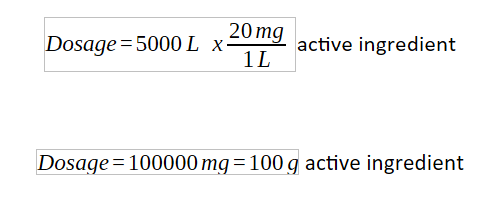
If you have a target dosage expressed in ppm, for example, for a 5,000 L tank at a dosage of 20 ppm:
20 ppm = 20 mg antifoam/kg final product or 20 ppm = 20 mg antifoam/L final product.
Dosage calculation
For a 5,000 L process volume:
If you use one of our solutions, such as Antifoamzera I20 (20% active ingredient, PDMS):
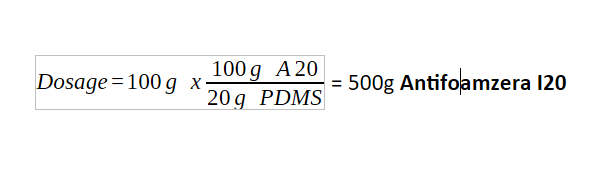
In other words, 500 g of Antifoamzera I20 are required, provided that the 20 ppm dosage refers directly to the commercial product.
Why isn't the antifoam I am using eliminating the foam?
The most common causes may include:
- Unsuitable product: The formulation is not compatible with the system. Although some products have a broad range of applications, there is no universal antifoam, so product selection must be approached carefully.
- Insufficient dosage: There is not enough active ingredient to control the foam. Be careful when calculating the dosage: what determines the calculation is the active ingredient, not simply the amount of commercial product containing it.
- Poor dispersion: The antifoam is not reaching the area where the foam is being generated effectively.
- Incorrect application point: The antifoam is being added at a point where foam is not an issue, or it is being added too late.
- Different process conditions: A change in temperature, pH, solids concentration, surfactants, or aeration can completely change foam behavior.
- Foam is being generated continuously: In these cases, a single application may not be sufficient and continuous dosing may be required. For this purpose, dilution is recommended to avoid exceeding applicable regulatory limits.
- Overdosing: Paradoxically, increasing the amount does not always improve the result.
Before increasing the dosage, it is advisable to review compatibility, the point of addition, and the process conditions.
What is the difference between an antifoam and a defoamer?
The terms are often used interchangeably in the industry, but technically they can be distinguished according to their function:
- Antifoam: primarily acts to prevent or reduce foam formation.
- Defoamer: primarily used to destroy foam that has already formed.
However, in the market, both terms are frequently used for products that perform both functions.
Which antifoam works best at high temperatures?
For high-temperature processes, a formulation specifically designed to maintain its thermal stability and antifoam activity under those conditions should be selected. Silicone-based systems often perform well in many high-temperature applications, but not all silicone-based products are equivalent. In addition to the maximum temperature, the following factors should be evaluated:
- Exposure time.
- pH.
- Medium composition.
- Presence of surfactants.
- Agitation.
- Solids concentration.
- Dosing method.
Therefore, it is important to keep in mind that temperature alone does not determine which antifoam will perform best.
What is the difference between a silicone-based and a non-silicone antifoam?
The main difference lies in the chemistry of the formulation.
Silicone-based antifoams
They generally offer:
- High efficiency.
- Rapid foam knockdown.
- Low application dosages.
- Good performance across numerous industrial processes.
- Good thermal stability in appropriately formulated products.
They are particularly attractive when high levels of foam control are required with a small amount of product.
Non-silicone antifoams
They may be formulated with mineral oils, vegetable oils, polymers, esters, or other components.
They may be preferable when:
- The presence of silicone must be avoided.
- There are specific restrictions related to the final product.
- Greater compatibility with certain formulations is required.
- The subsequent process is sensitive to silicone residues.
Therefore, silicone-based does not automatically mean better. It means that the formulation may offer certain advantages under specific conditions.
Why Partner With Us
30 Years Focused on Chemical Excellence
Backed by quality certifications, reliable logistics, and a comprehensive chemical portfolio tailored to your industry.

KOSHER
Certified

Agile
Reformulation

Permanent
Stock

Full Regulatory
Compliance

Technical
Sustainability

Organized
Logistics

Specialized
Consulting