
In the food industry, unwanted foam formation during production is a technical challenge that can affect both operating efficiency and final product quality. A familiar kitchen example helps explain the issue: when water is brought to a boil and pasta or potatoes are added, a dense layer of white foam can form within minutes and may boil over unless the heat is reduced or the pot is removed. But why does this happen?
Starches such as amylose and amylopectin, along with soluble proteins such as albumin, are released from the food into the hot water. These compounds behave as natural surfactants: they reduce the surface tension of water and form an elastic film around steam bubbles. Once trapped, the bubbles do not burst when they reach the surface; instead, they accumulate and create stable foam that can overflow if heat continues to be applied.
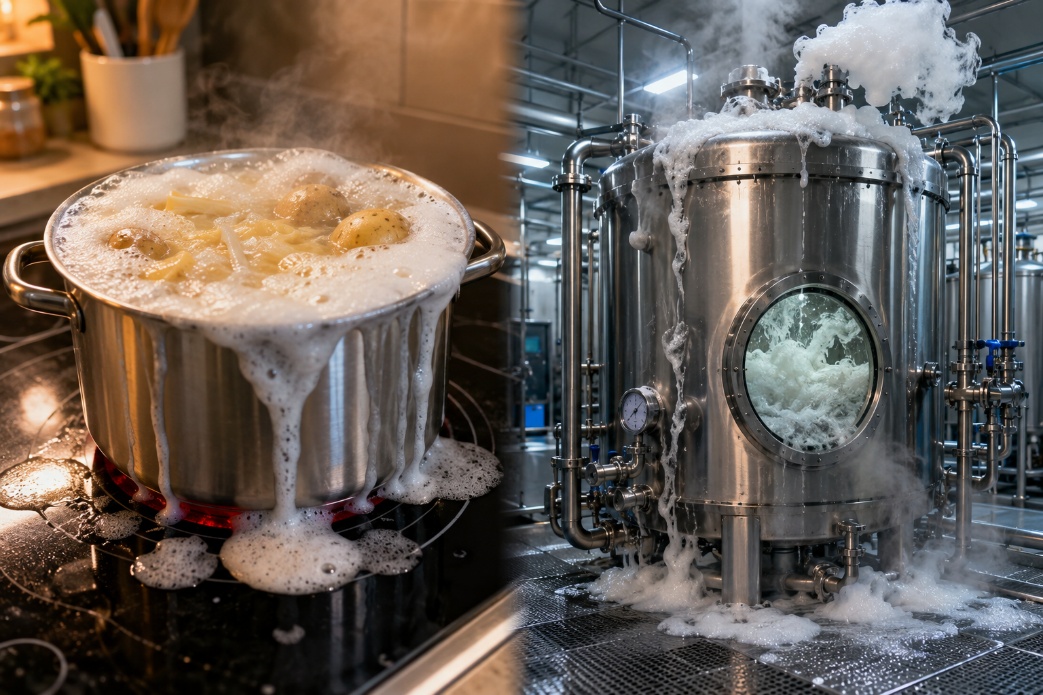
While this can be managed at home by lowering the heat, stirring, or even blowing on the foam, it becomes a serious technical, economic, and safety concern when scaled up to a production plant.
Direct Implications for the Food Industry
Production losses and downtime
In a 5,000-liter cooking vessel for sauce or puree, foam overflow does not simply mean wiping down a countertop. It can translate to losing hundreds of liters of finished product down the drain, shutting down the filling line, and spending hours cleaning electrical equipment and production surfaces, significantly increasing operating expenses (OPEX).
Higher energy consumption due to poor heat-transfer efficiency
Foam acts as a thermal insulator. In plate or tubular heat exchangers, the buildup of bubbles on the heat-transfer surface can sharply reduce the heat-transfer coefficient.
To reach the required pasteurization or sterilization temperature, the system must consume more energy or extend processing times, which may also affect the food’s sensory properties through overprocessing.
Critical filling and dosing issues
This is one of the most common challenges in beverage, sauce, and emulsified-oil filling lines. Volumetric dosing systems are designed to work with homogeneous liquids. Entrained air interferes with volumetric filling systems, leading to inaccurate fill volumes and off-spec net contents.
Pump cavitation and equipment wear
Foam and entrained air bubbles in food fluids pose a major risk for centrifugal and gear pumps. As a bubble passes through the impeller, it can collapse suddenly, a phenomenon known as cavitation, creating micro-impacts that erode blades, generate severe vibration and noise, and shorten the service life of rotors and mechanical seals.
Accelerated oxidation and loss of nutritional quality
Foam traps oxygen inside the product, accelerating oxidation reactions. In sensitive foods such as fruit juices, dairy products, and emulsified sauces, dissolved oxygen accelerates enzymatic and lipid oxidation.
This leads to nutrient loss, color changes, and the development of rancid or cooked off-notes, significantly reducing the shelf life of the finished product.
Operator safety risks and cross-contamination
Overflow of hot liquids above 90 °C from tanks or kettles creates steam-filled environments and extremely slippery surfaces, increasing the risk of burns and falls for operators.
In Clean-in-Place (CIP) systems, residual foam can also reduce the effectiveness of alkaline and acidic detergents, leaving biofilm and organic residues that may contaminate subsequent batches.
So, what can chemistry do to solve this problem?
food-processing antifoams have become a key technical solution for addressing foam-related challenges, helping optimize processes ranging from beverage manufacturing to complex food processing operations.
Antifoam vs. Defoamer: A Technical Distinction
Although the terms are often used interchangeably, antifoams and defoamers perform different technical functions. Antifoam is preventive: it inhibits the formation of new bubbles by lowering the surface tension of the medium.
A defoamer, by contrast, acts on foam that has already formed by penetrating the bubbles and breaking their structure. In everyday food industry language, however, the term “antifoam” is commonly used to refer to both functions, since most commercial formulations are designed to provide both preventive and corrective foam control depending on the application point and dosage.
What is a food-grade antifoam?
An antifoam, or antifoaming agent, is a chemical additive used to reduce or inhibit foam formation in liquids during industrial processes. In food applications, these additives are used to prevent, control, or reduce foam in liquid or solid food systems.
Foam in food production can develop during mixing, agitation, boiling, fermentation, transfer, or filling. As discussed above, it can cause product defects, interfere with efficient container filling, and compromise final quality. Antifoams work by reducing surface tension and destabilizing foam films, causing air bubbles to rupture and surface foam to break down.
Regulatory Framework for Food-Grade Antifoams
Food-grade antifoams rank among the most tightly regulated processing additives in the food industry. For an antifoam to be used in food manufacturing, it must comply with the applicable food safety regulations in each market where the product is manufactured, distributed, or consumed.
European Union
The key reference regulation is Commission Regulation (EU) No. 231/2012, which establishes purity specifications for food additives, alongside Regulation (EC) No. 1333/2008. For polydimethylsiloxane, identified as E 900, direct additive use is permitted in the EU, provided the applicable use restrictions are observed.
United States
In the United States, the FDA permits specific defoaming agents for designated food-processing applications under defined conditions of use established in Title 21 CFR. Section 21 CFR 173.340 ("Defoaming agents") is particularly relevant, as it allows certain defoaming agents to be safely used in food processing as secondary direct food additives for human consumption, subject to the conditions and limitations described in the regulation.
Beyond government regulations, many food-processing antifoams also carry voluntary certifications such as Kosher and Halal, which can be important for specific markets, customers, and consumer segments.
Types of Food-Grade Antifoams
Food-grade antifoams are available in several chemistries, each with specific performance characteristics and application ranges. The main groups include:
Silicone-Based Antifoams
Silicone-based antifoams are highly effective for controlling foam in aqueous systems and are used across a wide range of applications, including juice production, carbonated beverages, and processed foods. Polydimethylsiloxane (PDMS) is one of the most common compounds in this category.
These products are typically supplied as emulsions or powders. For example, food-grade silicone antifoam powders can be added to dry products, such as microwaveable cereal mixes, to prevent foam formation when liquids are added at the point of use.
Organic Antifoams (Non-Silicone)
Where silicone use is restricted, organic antifoams offer an effective and versatile alternative. These agents may be formulated with mineral oils, vegetable oils, polyols, polypropylene glycol (PPG) polymers, or polyethylene glycol (PEG). Mechanistically, the antifoam is insoluble in the aqueous medium and disperses as droplets that penetrate the surfactant film, displace it, and trigger bubble collapse.
These antifoams generally require slightly higher dosages than silicone-based products and may have a shorter service life in high-shear or high-temperature processes due to susceptibility to thermal degradation or saponification in alkaline media.
Antifoams as food additives vs. processing aids
Antifoams can fall into two main categories depending on their role in the process:
Food Additive:
Used to deliver a technical effect on the food consumed directly by the end user (e.g., foam control in a powdered beverage formulation).
Processing Aid:
Used during food manufacturing, with any residue in the consumable product being incidental (e.g., antifoams used in the production of sauces or carbonated beverages).
This distinction has important regulatory implications, as requirements differ depending on the applicable legislation and intended use.
Key considerations when selecting an antifoam
When selecting a food-grade antifoam, several factors should be evaluated:
Compatibility with the Food Matrix:
The antifoam must be compatible with the food system in which it will be used.
Process Conditions:
Temperature, pH, shear, and processing time can all affect antifoam performance.
Appropriate Concentration:
The optimal dosage should achieve the required foam control without compromising food quality.
Safety and Regulatory Compliance:
The product must meet applicable food safety and regulatory requirements.
Organoleptic Neutrality:
The antifoam should not alter the food's odor, flavor, color, or other sensory attributes.
Technical Capabilities of ZeraChem Products
To illustrate the real-world capabilities of food-grade antifoams, we have referenced technical information for two representative products from our portfolio for industrial applications: Antifoamzera Powder (Food USP) and Antifoamzera A30 USP. Both are based on silicone chemistry, specifically polydimethylsiloxane, but their formats and application ranges differ significantly.
Antifoamzera Powder (Food USP)
This product is supplied as a powder formulated with hydrophobic additives incorporated into a polydimethylsiloxane (PDMS) matrix and encapsulated in carriers that support efficient dispersion in the foam-forming medium. Reference technical parameters include:
| Technical Parameter | Value |
|---|---|
|
PDMS content |
≤ 20 % |
|
Moisture |
< 7.0 % |
|
pH (solution) |
4.0 – 7.0 |
|
Water solubility |
60 – 100 % |
|
Mesh size |
≈ 80 |
|
Shaker test performance (10 seconds at 450 OSC/min) |
≤ 0.5 cm residual foam |
This antifoam is especially effective against difficult foams, supporting both surface-foam knockdown and the release of entrained air from the liquid medium. Documented applications for this powder include alcohol distillation processes such as brandy and tequila, fermentation, confectionery and chocolate manufacturing, cooking seasonings, shakes, dairy products, coffee, juices, fruit concentrates, and jams. It may also be used in pharmaceutical products intended for gastritis, hyperacidity, and flatulence.
Antifoamzera A30 USP
Antifoamzera A30 USP is a viscous white liquid formulated specifically for aqueous media. Its active component is a silicone compound, dimethylpolysiloxane, combined with hydrophobic additives and nonionic FDA-grade emulsifiers to support rapid, uniform dispersion. The product is Kosher certified and analyzed under USP standards, supporting its suitability for food and pharmaceutical applications. Reference technical data are shown below:
| Technical Parameter | Value |
|---|---|
|
Total solids content (100 °C) |
27 – 34 % |
|
Viscosity (25 ± 2 °C, Brookfield LVD sp63/20 rpm) |
500 – 2000 cP |
|
Recommended dosage range |
50 – 150 ppm |
|
Storage stability (under proper conditions) |
1 year |
|
pH (solution) |
3.0 – 7.0 |
|
Shaker test performance (10 seconds at 450 OSC/min) |
≤ 0.5 cm residual foam |
A30 has a broad application range that includes:
FAQ - Frequently Asked Questions
What are antifoams in food?
Food-grade antifoams are processing additives that prevent or eliminate foam generated during food manufacturing. They improve process stability, filling accuracy, heat transfer, and overall production efficiency without affecting product quality when used according to regulatory requirements.
What types of antifoams are available?
Common antifoams used in the food industry include silicone-based antifoams (highly effective in aqueous systems), organic or non-silicone antifoams (based on vegetable oils or other approved chemistries), and polymer-based antifoams, which may be selected for demanding process conditions.
Each type has specific performance characteristics and should be evaluated according to the process requirements and regulatory context.
What are anticaking agents in food?
Anticaking agents are food additives that absorb excess moisture in powdered or granular solid foods, preventing particles from clumping and forming lumps. They are used in products such as powdered milk, grated cheese, sugar, instant soups, flour, and table salt.
Common examples include calcium carbonate (E 170), magnesium carbonate (E 503), ferrocyanides (E 535, E 536), and amorphous silica (E 551).
References
- (1) Deotale, S. M.; Dutta, S.; Moses, J. A.; Anandharamakrishnan, C. Foaming and Defoaming–Concepts and Their Significance in Food and Allied Industries: A Review. Discover Chemical Engineering 2023 3:1 2023, *3* (1), 9-. https://doi.org/10.1007/s43938-023-00025-6.
- (2) Function Category 33: Defoamer. https://comptox.epa.gov/chemexpo/functional_use_category/33/ (accessed 2026-03-18).
- (3) Denkov, N. D. Mechanisms of Foam Destruction by Oil-Based Antifoams. Langmuir 2004, *20* (22), 9463–9505. https://doi.org/10.1021/la049676o.
- (4) Lista de sustancias químicas más seguras | US EPA. https://espanol.epa.gov/saferchoice/lista-de-sustancias-quimicas-mas-seguras#searchList (accessed 2026-03-18).
- (5) Simethicone: Uses, Interactions, Mechanism of Action | DrugBank. https://go.drugbank.com/drugs/DB09512 (accessed 2026-03-18).
Disclaimer
The information provided in this article is intended solely for general informational and educational purposes. It does not constitute technical, engineering, regulatory, legal, or application-specific advice and should not be relied upon as the sole basis for product selection, process design, or operational decisions.
All technical information, product descriptions, performance data, and application examples are provided in good faith based on information believed to be accurate at the time of publication. However, actual product performance may vary significantly depending on raw materials, formulations, equipment design, processing conditions, operating parameters, environmental factors, and other variables beyond our control.
Nothing contained in this publication should be interpreted as a guarantee, warranty, or representation—express or implied—including, but not limited to, warranties of merchantability, fitness for a particular purpose, or suitability for any specific manufacturing process or application.
Users are solely responsible for evaluating the suitability of any product for their intended use and for verifying compliance with all applicable laws, regulations, industry standards, and customer-specific requirements. Appropriate laboratory evaluations, pilot trials, validation studies, and compatibility testing under actual operating conditions should always be performed before commercial implementation.
For complete technical specifications, recommended operating conditions, safety information, storage requirements, handling procedures, regulatory status, and product limitations, always consult the latest official Technical Data Sheet (TDS), Safety Data Sheet (SDS), and any other product documentation provided by the manufacturer before use.
Let’s start your next project.
Let’s start your next project
Describe your needs and let’s put the plan into action: technical assessment, samples for your validation and approval, and full support to implement the raw material that best fits your requirements and process.
We’re ready!
Why Partner With Us
30 Years Focused on Chemical Excellence
Backed by quality certifications, reliable logistics, and a comprehensive chemical portfolio tailored to your industry.

KOSHER
Certified

Agile
Reformulation

Permanent
Stock

Full Regulatory
Compliance

Technical
Sustainability

Organized
Logistics

Specialized
Consulting