In industrial operations, cleaning is far more than a cosmetic concern; it is a critical process variable that directly affects equipment lifespan, product quality, and facility safety. For example, steel parts may pass dimensional inspection yet fail paint adhesion because machining oils remain trapped in the surface profile. In these cases, selecting the correct industrial degreaser and applying it under appropriate conditions is essential to prevent costly downstream failures and ensure reliable production performance. Among the most widely used chemical tools across industrial sectors is the industrial degreaser, a product whose performance depends not only on its formulation but also on technically sound application practices.
An industrial degreaser is a cleaning agent specifically formulated to break down, emulsify, or dissolve grease, mineral oils, hydrocarbons, and particulate soils adhered to surfaces and machinery. Its action is driven by chemical mechanisms that may be alkaline, neutral, or acidic, depending on the contaminant to be removed [1]. Table 1. Chemical nature of industrial degreasers
| Chemical Type | pH | Mechanism | Typical Soil | Example Active Ingredient | Not Recommended For |
|---|---|---|---|---|---|
|
Alkaline |
>10 |
Saponification of esters |
Animal fats, vegetable oils, fatty acids |
NaOH + sodium silicate |
Aluminum, zinc, brass |
|
Neutral |
6 – 8 |
Micellar emulsification |
Light oils, fingerprints, greasy dust |
Alkyl polyglucosides |
Carbonized grease; limited removal performance |
|
Acidic |
<4 |
Oxide attack/complexation + emulsification |
Rust, scale, grease-bearing oxides |
Phosphoric acid + surfactant |
Uninhibited metals, hard chrome |
|
Sulfonic acid |
1.5–3.0 neat / 6–8 when neutralized |
Emulsification through anionic surfactant activity; no saponification or oxide attack |
Mineral oils, heavy greases, hydrocarbons |
LABSA (linear alkylbenzene sulfonic acid) |
In its neat acidic form: attacks sensitive metals such as aluminum and copper if not neutralized |
Alkaline degreasers, for example, work by saponifying animal and vegetable fats, while solvent-based degreasers dissolve oils through molecular affinity. This distinction is critical because the chosen chemistry determines not only cleaning efficiency but also the integrity of the materials being treated.
Criteria for Selecting the Right Degreaser
The quality of an industrial degreaser is measured by how well it aligns with four critical variables [2]:
Soil Type
Machining grease, cutting oil, process residues, or light contamination.
Surface Material
Ferrous metals, aluminum, engineering plastics, glass, or painted surfaces.
Application method
Immersion, spray, ultrasonic cleaning, or manual cleaning.
Regulatory requirements
Biodegradability, food-contact suitability, or environmental compliance.
Today’s market includes alkaline degreasers for ultrasonic systems, versatile concentrates with broad dilution ranges, and biodegradable formulations that deliver strong cleaning performance without compromising safety or sustainability objectives.
“The professional recommendation is to always request the technical data sheet and, when in doubt, run preliminary tests on a small area.”
Applications and Operational Versatility
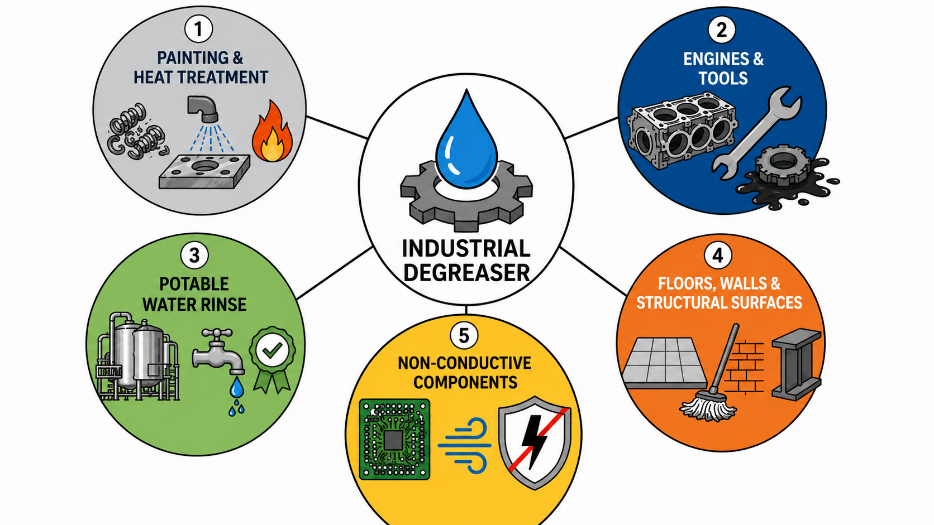
Industrial degreasers are used across virtually every production sector. In metalworking, they are essential for removing machining oils and residues that can interfere with downstream processes such as painting or heat treatment. In the automotive industry, they are routinely used on engines, tools, and components with embedded soils.
They are also used in the food and beverage industry, provided that application-specific products are selected and followed by a potable-water rinse. In general maintenance, industrial degreasers are applied to plant floors, walls, metal structures, and stainless-steel equipment. There are also versions designed for electrical and electronic components, though these require non-conductive, fast-drying formulations.
Technical Data Sheets: The Foundation of Proper Product Selection
While general guidelines are useful for understanding industrial degreaser technologies, product-specific performance claims, including biodegradability, corrosion protection, material compatibility, dilution ratios, and recommended applications, should always be verified against the manufacturer’s official Technical Data Sheet (TDS).
Because formulations vary significantly between suppliers, engineering decisions should rely on documented technical specifications rather than generalized product categories. Reviewing the TDS, together with the Safety Data Sheet (SDS), helps ensure proper product selection, regulatory compliance, and safe operation under actual process conditions.
Disclaimer: This guide is provided for general informational and reference purposes only. For complete technical specifications, detailed application parameters, and comprehensive compatibility data, please request the official product technical data sheets directly from the manufacturer.
It is the sole responsibility of the end-user to thoroughly consult all relevant technical and safety documentation prior to product selection, dilution, and application, and to conduct appropriate on-site compatibility testing under actual working conditions.
Frequently Asked Questions
What is an industrial degreaser?
An industrial degreaser is a cleaning agent specifically formulated to remove grease, mineral oils, hydrocarbons, and particulate soils adhered to surfaces and machinery. Its action is based on chemical mechanisms that may be alkaline, neutral, or acidic.
Products such as ZERABIO-P fall into the neutral to slightly acidic category (pH 4.0–7.0), as they use biodegradable nonionic surfactants to emulsify hydrocarbons without relying on strong bases or aggressive mineral acids.
Should degreaser be rinsed off with water?
Yes, in most cases. Rinsing with water is a key step because emulsified or dissolved grease must be mechanically carried away to prevent redeposition on the surface.
For cleaning mechanical parts with ZERABIO-P, after rinsing and drying, the technical data sheet recommends immersing the parts in diesel fuel to protect them from oxidation.
The process should always end with a visibly clean surface that is free of product residue to ensure maximum operational effectiveness.
What are the best industrial degreasers?
Product excellence is measured by how well the formulation aligns with four critical variables:
- Soil type: Machining grease, cutting oil, process residues, or light contamination.
- Surface material: Ferrous metals, aluminum, engineering plastics, glass, or painted surfaces.
- Application method: Immersion, spray, ultrasonic cleaning, or manual cleaning.
- Regulatory requirements: Biodegradability (such as the 62.2% certification referenced for ZERABIO-P), food-contact suitability, or environmental compliance.
At ZeraChem, we work with two product approaches:
Zerabio-P
A ready-to-use degreasing solution, free of phosphates, acids, and bases. It is designed for hydrocarbon spills, machinery cleaning, and mechanical parts. It does not cause corrosion on metals, plastics, or electrical terminals.
Zerabreak-P
A biodegradable base for developing degreaser formulations. It works as a partial substitute for sulfonic acid (LABSA), reducing dependence on this petrochemical raw material by up to 50%, lowering costs, and improving the environmental profile.
What is an industrial degreaser?
One of the most frequently asked questions in the sector is which degreaser delivers the most power. From a technical standpoint, cleaning power is not an absolute attribute, it must be evaluated based on the type of soil and the substrate to be cleaned.
In practice, performance depends on the synergy between the product, the soil, the temperature, and the application method.
For solidified animal or vegetable fats:
Alkaline degreasers are chemically fast due to the saponification mechanism.
For heavy, polymerized mineral greases:
Such as sulfurized cutting oil: Solvent-based degreasers or heated alkaline systems offer maximum aggressiveness.
Can For universal, safer, and more sustainable cleaning:-P be used beyond industrial cleaning applications?
Neutral or mildly acidic degreasers with high-performance surfactants—such as the ZERA line—offer an excellent balance of cleaning efficiency, material compatibility, and environmental compliance. Their strength lies in reducing interfacial tension and forming stable microemulsions that remove grease without corroding sensitive metals such as aluminum or zinc.
What can be cleaned with an industrial degreaser?
Industrial degreasers are used across virtually every production sector:
Metalworking
Removal of machining oils and residues that interfere with downstream processes such as painting or heat treatment.
Automotive industry
Cleaning of engines, tools, pistons, connecting rods, valves, and crankshafts with embedded soils.
Food and beverage industry
When application-specific products are used and followed by a potable-water rinse.
General maintenance
Industrial floors, walls, metal structures, and stainless-steel equipment.
Electrical and electronic components
Certain versions are designed with non-conductive, fast-drying formulations, such as those referenced in the ZERABIO-P technical information for electrical terminals.
Are industrial degreasers and WD-40 the same?
No. Chemically and functionally, they are different products:
WD-40 Multi-Use Product
Is primarily a lubricant and rust-prevention product with water-displacing properties. Its cleaning action is secondary.
WD-40 Specialist®
Does include a degreaser line, but those products are formulated with solvent-based chemistry.
An industrial degreaser, such as ZERABIO-P
Is designed to emulsify and remove grease and soils, not to lubricate.
Using a lubricant as a degreaser can redistribute grease rather than remove it, compromising downstream processes such as painting or heat treatment.
How should a degreaser be diluted?
Dilution depends on the specific product and soil load. There is no universal rule, but the following are standard technical references commonly used in the market:
| Soil Level | Dilution Ratio | Product per Liter of Water |
|---|---|---|
|
Light cleaning (floors, walls) |
1:100 |
10 ml |
|
Medium-duty cleaning (vehicle bodies, structures) |
1:10 a 1:12 |
~83 – 100 ml |
|
Heavy soil (machinery, engines) |
1:3 a 1:5 |
200 – 250 ml |
|
Extreme cleaning / ultrasonic systems |
3% |
30 ml |
ZERABIO-P specific case: For cleaning automotive parts by immersion, the technical data sheet recommends 1 part product to 2 parts water (1:2), with parts immersed for 5 minutes. For manual cleaning with a brush or spray bottle, it is recommended to use the product undiluted and then add water to emulsify.
Which surfaces should not be cleaned with degreaser?
Restrictions depend on the chemical nature of the degreaser:
| Degreaser Type | Prohibited Surfaces or Surfaces Requiring Extreme Caution |
|---|---|
|
Alkaline (pH > 10) |
Aluminum, zinc, brass, and bronze; these materials may be attacked by corrosion. It may also hydrolyze certain plastics such as PET or polycarbonate. |
|
Strong acid (pH < 3) |
Uninhibited metals, hard-chromed surfaces, and high-strength steels due to the risk of hydrogen embrittlement. |
|
Chlorinated solvents [3] |
Plastics and painted surfaces; they may dissolve or damage the finish. |
|
Neutral / mild acidic formulations (ZERA) |
No severe restrictions are declared because they do not cause oxidation or deterioration of metal parts, electrical terminals, or plastics. However, a small-area compatibility test is always recommended before full-scale application. |
Rule of thumb: If compatibility is uncertain, always perform a test on a small, inconspicuous area.
References:
- [1] “Cleaners & Degreasers – Blurred Lines | Simple Science of Degreasers.” Accessed: Jul. 12, 2026. [Online]. Available: https://www.nycoproducts.com/resources/blog/cleaners-degreasers-blurred-lines/.
- [2] “Variables to consider when specifying degreasing products-and how to choose the optimal solution for your operation” [Online]. Available: https://www.itwprobrands.com/files/white_paper/Industrial_Degreasing_Cleaning_101_WhitePaper_200623-2.pdf.
- [3] “Handbook of Cleaning Solvents – Buscar con Google.” Accessed: Jul. 14, 2026. [Online].
Let’s start your next project.
Let’s start your next project
Describe your needs and let’s put the plan into action: technical assessment, samples for your validation and approval, and full support to implement the raw material that best fits your requirements and process.
We’re ready!
Why Partner With Us
30 Years Focused on Chemical Excellence
Backed by quality certifications, reliable logistics, and a comprehensive chemical portfolio tailored to your industry.

KOSHER
Certified

Agile
Reformulation

Permanent
Stock

Full Regulatory
Compliance

Technical
Sustainability

Organized
Logistics

Specialized
Consulting